Čeština
  Deutsch
  Español
  Français
  Italiano
  Magyar
  Nederlands
  Polski
  Português
  Slovenčina
  Türkçe
  Русский
  中文
中文  한국의
한국의 KOBOLD Instruments Inc • 1801 Parkway View Drive • 15205 Pittsburgh, PA • Tel: +1 412 788 2830 • E-mail: Please activate JavaScript • visit koboldusa.com

 Conductive Level Monitoring

Frequently Asked Questions (FAQs) About Conductive Level Switches
What is a conductive level switch?
A conductive level switch is a point level sensor that detects the presence or absence of an electrically conductive liquid at a defined position in a tank, vessel, or pipe It operates by detecting electrical conductivity through the liquid between a sensing electrode and a reference electrode or, in some applications, between the sensing electrode and the conductive metal tank wall. When the liquid reaches the sensing point, it completes the measuring circuit and the switch changes its output state.
Conductive level switches are commonly used for high- and low-level alarms, overfill protection, dry-run protection, and automatic pump or valve control. With no moving mechanical parts, they provide reliable, low-maintenance level detection for many liquids.
Which liquids can a conductive level switch detect?
A conductive level switch can detect electrically conductive liquids such as water, wastewater, aqueous solutions, acids, alkalis, and many process liquids. It can also be used with viscous conductive liquids if the medium meets the minimum conductivity specified for the instrument. Non-conductive liquids including oils, fuels, and most organic solvents—cannot reliably complete the measuring circuit and therefore require a different level detection technology.
What are electrically conductive liquids?
Electrically conductive liquids contain dissolved ions that allow electric current to flow. Examples include water with dissolved salts or minerals, acids, alkalis, and many aqueous chemical solutions. Conductive level switches use this ionic conductivity to detect whether liquid is touching an electrode.
How does a conductive level switch work?
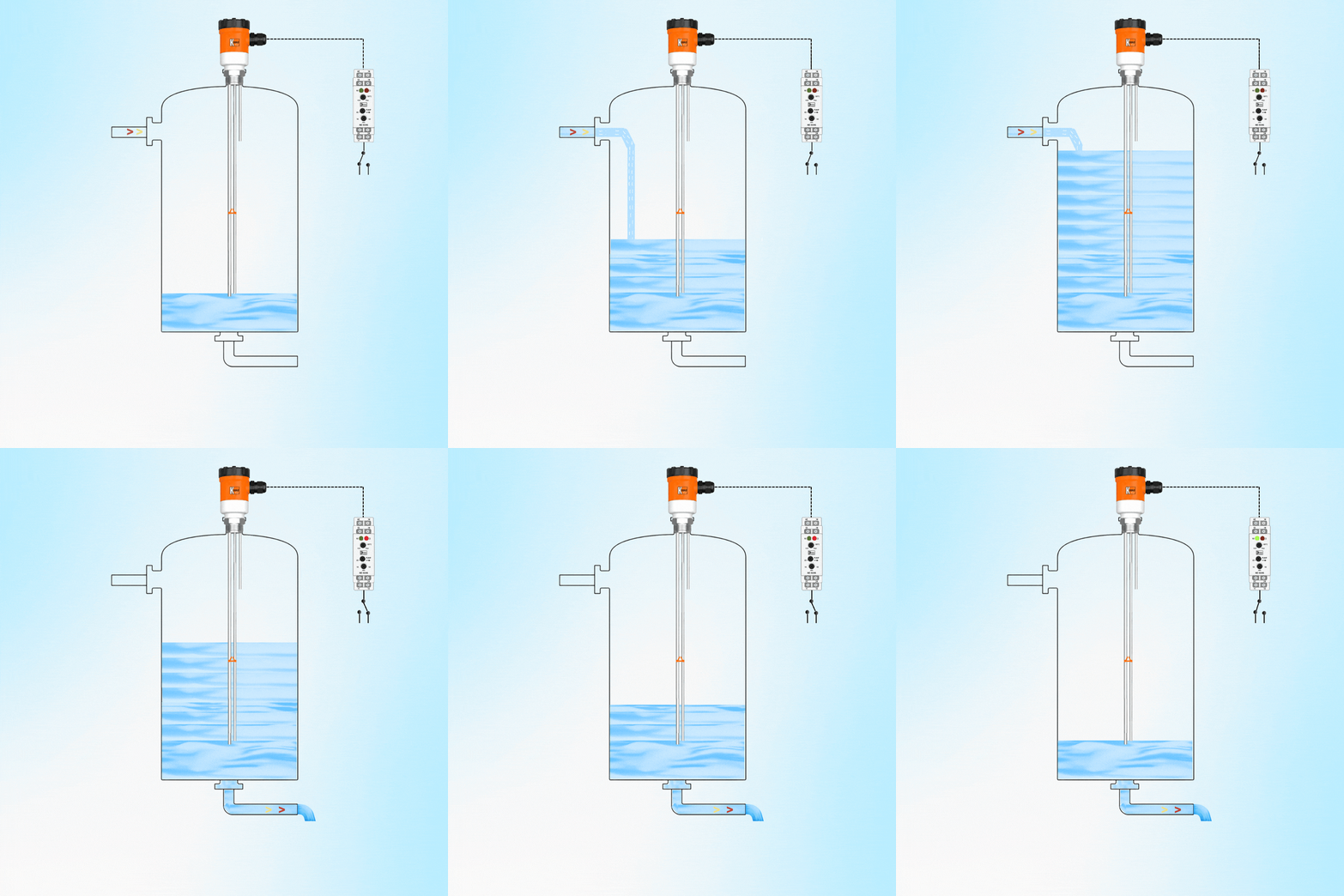
A conductive level switch detects whether a conductive liquid has reached a defined switching point by evaluating the electrical resistance between a sensing electrode and a reference electrode.
One or more sensing electrodes are installed at the required switching levels inside the vessel. A reference electrode, which normally remains immersed in the liquid, completes the measuring circuit. In a sufficiently conductive, unlined metal tank, the tank wall may serve as the reference electrode. Tanks made of plastic, concrete, or other non-conductive materials require a separate reference electrode.
The associated controller or electrode relay applies a low alternating voltage between the sensing electrode and the reference electrode. When the liquid reaches the sensing electrode, it creates a conductive path through the liquid. Current begins to flow, and the electrical resistance between the electrodes decreases. When the resistance falls below the configured switching threshold, the controller changes the state of its relay or switching output. Alternating voltage is used to minimize electrode polarization, electrolysis, and undesirable oxidation.
When the liquid falls below the sensing electrode, the conductive path is interrupted and the output changes according to the configured switching logic. Depending on the number and arrangement of the electrodes, the system can provide single-point level detection or minimum/maximum level control.
Operating principle of a conductive level switch
The operating principle is based on the electrical conductivity of the process liquid. Unlike a float switch, the conductive measuring system has no moving sensing mechanism. It detects whether the liquid has created a conductive electrical path between a sensing electrode and a reference electrode. In a suitable unlined metal tank, the tank wall may serve as the reference electrode. This principle enables simple, reliable point-level detection with minimal maintenance.
What applications are conductive level switches suitable for?
Conductive level switches are used for point level detection in electrically conductive liquids. Typical functions include high-level and low-level alarms, overfill protection, dry-run protection, and automatic pump or valve control in tanks, vessels, and pipes.
Typical industrial applications include
- Water and wastewater treatment: monitoring water, wastewater, sludge, and chemical dosing tanks.
- Chemical processing: detecting conductive acids, alkalis, and aqueous process solutions
- Food and beverage production: monitoring conductive products in storage, mixing, and process vessels., subject to hygienic and material requirements
- Pharmaceutical production: point level detection in suitable conductive process liquids, subject to hygienic and validation requirements
- Boilers, cooling systems, and industrial utilities: maintaining liquid levels and protecting pumps and other equipment
The process liquid must meet the minimum conductivity specified for the selected switch or controller. Oils, fuels, most organic solvents, and highly purified or deionized water are generally unsuitable unless the device is specifically designed for the application.
For detailed-specific guidance and expert support, consult our engineer to ensure proper selection and long-term performance.
What are the advantages of a conductive level switch?
Conductive level switches provide a simple, reliable, and cost-effective method of point level detection in electrically conductive liquids.
Key advantages include:
- No moving sensing parts, resulting in low wear and minimal maintenance
- Fast response for reliable alarm and control functions
- Suitability for many conductive liquids, including water, wastewater, acids, alkalis, and aqueous chemical solutions
- Single- or multi-electrode configurations for point-level detection or minimum/maximum level control
- Compact designs suitable for installations with limited space
- Flexible integration with electrode relays, controllers, PLCs, pumps, valves, and alarm systems
- Adaptability to different process conditions through the appropriate selection of electrode and insulation materials
- Cost-effective use in overfill protection, dry-run protection, pump control, and automatic filling or emptying systems
What are the limitations of a conductive level switch?
Conductive level switches are reliable for suitable liquids, but several limitations must be considered during selection and installation:
- They detect only liquids with sufficient electrical conductivity. Oils, fuels, most organic solvents, and very pure water generally cannot be detected reliably.
- Insulating deposits, such as scale or crystallized material, can coat the electrode and prevent switching. Conductive deposits, product bridges, or conductive foam may cause premature or false switching.
- Aggressive media can corrode unsuitable wetted parts. The electrode, insulation, seal, and process-connection materials must therefore be chemically compatible with the liquid.
- The measuring circuit requires a reference electrode or a suitable conductive tank wall. Non-conductive vessels require a separate reference electrode.
- Conductive switches provide point level detection rather than continuous level measurement.
- Liquids near the device’s minimum conductivity limit may not be detected reliably. In such cases, the switching sensitivity—if adjustable—must be correctly configured and reliable operation should be verified under actual process conditions.
Correct material selection, suitable electrode positioning, and cleaning when required help ensure reliable long-term operation.
What does µS/cm mean in conductive level measurement?
Microsiemens per centimetre (µS/cm) is a unit of electrical conductivity. It indicates how readily a liquid conducts electric current and is therefore a key selection parameter for conductive level switches.
The process liquid must meet or exceed the minimum conductivity specified for the selected switch or controller. For example, if the minimum required conductivity is 20 µS/cm, a liquid below that value may not generate a reliable switching signal. Conductivity can change with temperature and composition, so the lowest conductivity expected under actual process conditions should be considered.
What type of electrical conductivity is used in conductive level detection?
Conductive level detection relies on electrolytic—or ionic—conductivity. In a liquid, dissolved ions carry the electrical current between the sensing electrode and the reference electrode.
- Electronic conductivity occurs mainly in metals and other conductive solids, where electrons carry the current.
- Electrolytic conductivity occurs in liquids containing mobile ions. and is the relevant principle for conductive level switches.
- Semiconductor conductivity occurs in semiconductor materials, where conductivity is controlled by the movement of electrons and holes and is widely used in electronic devices.
For reliable switching, the liquid must contain enough mobile ions to exceed the minimum conductivity threshold of the selected instrument.
What pressure and temperature ranges are available for conductive level switches?
The permissible process pressure and temperature depend on the model, electrode design, process connection, seal, insulation, and materials of construction. Conductive level switches are available for applications ranging from atmospheric tanks to pressurized vessels and from ambient to elevated process temperatures.
Depending on the KOBOLD model, available ratings may include:
Process pressure: from atmospheric applications up to 30 bar
Process temperature: up to 150 °C, with selected versions suitable for elevated-temperature cleaning processes such as CIP
Always check the data sheet for the exact permissible pressure, temperature, conductivity, and material limits of the selected model. All process conditions must remain within the specified ratings.
What types of conductive level switches are available?
Conductive level switches are available in different configurations to suit the required number of switching points, vessel geometry, installation method, and control function.
Common configurations include:
- Single-point conductive level switches for one high-level or low-level alarm, overfill alarm, dry-run alarm, or control point
- Multi-point conductive level switches with several electrodes for multiple switching levels or staged pump and valve control.
- Single-channel controllers that monitor one electrode circuit and provide one switching function
- Multi-channel controllers that monitor several electrode circuits and provide independent switching functions.
Electrode designs include rigid rod electrodes, suspended cable electrodes, and removable or cut-to-length electrodes. The most suitable design depends on tank height, mounting position, liquid movement, deposits, pressure, temperature, and chemical compatibility.
The number of electrodes, controller channels, outputs, process connections, and installation options varies by model.
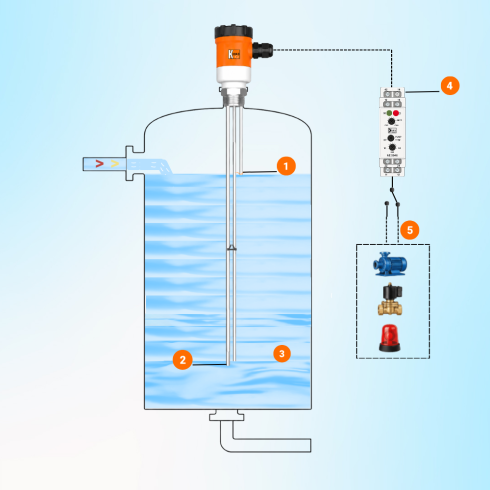
What are the main components of a conductive level switch system?
A conductive level switch system uses electrodes, the conductive process liquid, a controller or relay, and an output circuit to detect a defined liquid level and generate a control signal.
Common applications include:
- Sensing electrode: Installed at the required switching point, it makes electrical contact with the liquid. Electrode materials such as stainless steel, titanium, or Hastelloy are selected according to the process medium and operating conditions.
- Reference electrode: Completes the measuring circuit. A suitable conductive metal tank wall may act as the reference; non-conductive vessels require a dedicated reference electrode.
- Conductive process liquid: Forms the ionic current path between the sensing and reference electrodes when it reaches the switching point.
- Controller or relay unit: Applies a low alternating sensing voltage, evaluates the current or resistance between the electrodes, and changes the output when the configured threshold is reached.
- Output circuit: Sends the switching signal to pumps, valves, alarms, indicators, PLCs, or other automation equipment.
Does a conductive level switch require maintenance?
Conductive level switches are generally low-maintenance because they have no moving sensing parts. However, they are not maintenance-free in every application. Inspect the electrodes periodically for scale, deposits, crystallisation, or corrosion, and clean them when necessary. The appropriate interval depends on the process medium and operating conditions. Regular functional testing is recommended, especially for safety-related functions such as overfill and dry-run protection.
How should a conductive level switch be installed?
Conductive electrodes are commonly installed from the top of a tank or vessel, with each electrode ending at the required switching level. Side or angled installation may also be possible, depending on the model. Follow the manufacturer’s instructions and position the electrodes away from filling jets, heavy turbulence, agitators, vessel walls, and conductive internals that could cause unstable or false switching.
Long rod electrodes may require mechanical support to prevent bending or movement caused by vibration, turbulence, or lateral forces. Any support near an uninsulated measuring section must be electrically non-conductive and chemically compatible. In non-conductive tanks, install a separate reference electrode. Ensure that deposits cannot bridge adjacent electrodes and that the process connection, sealing materials, wiring, and grounding comply with the application requirements.
How do I select the right conductive level switch?
To select a conductive level switch for reliable, long-term operation, evaluate the process liquid, operating conditions, installation, and required control function. Key selection criteria include.
- Minimum required electrical conductivity of the process liquid: >20 μS/cm, ensure the process liquid is within the conductivity range supported by the device
- Chemical compatibility of all wetted materials, including the electrodes, insulation, seals, and process connection
- Process pressure and temperature, including cleaning and sterilisation conditions
- Electrode configuration, material, coating, length, spacing, and protection against bending or contact with the vessel
- Required number of switching points and control function, such as high-level alarm, low-level alarm, overfill protection, dry-run protection, or minimum/maximum control
- Availability of a separate reference electrode or a suitable electrically connected, unlined metal tank wall
- Installation position, available mounting space, turbulence, foam, deposits, and possible product bridging
- Process connection, electrode type, electrode length, and any required mechanical support
- Compatibility with the controller, relay, PLC, supply voltage, and required output signal
- Ambient conditions, ingress protection, vibration, humidity, and hazardous-area approvals where applicable
Matching these parameters to the technical data of the selected KOBOLD conductive level switch helps ensure dependable switching, long service life, and safe process control.
To learn more about conductive level switch selection and technical specifications, consult one of our experts or refer to the product documentation.