Čeština
  Deutsch
  Español
  Français
  Italiano
  Magyar
  Nederlands
  Polski
  Português
  Slovenčina
  Türkçe
  Русский
  中文
中文  한국의
한국의 KOBOLD Instruments Inc • 1801 Parkway View Drive • 15205 Pittsburgh, PA • Tel: +1 412 788 2830 • E-mail: Please activate JavaScript • visit koboldusa.com

 Digital Pressure Gauges

Frequently Asked Questions – Digital Pressure Gauges
What is a Digital Pressure Gauge?
A digital pressure gauge is an electronic device used to measure and display the pressure of gases, liquids, or vapours with high precision. It operates by converting pressure into an electrical signal through electronic sensors, which is then shown on a digital display—typically in units such as bar, psi, or kPa. These gauges offer superior accuracy and readability compared to analogue types and may include additional features such as data logging, overpressure alerts, and unit conversion. Digital pressure gauges are widely used across industrial, scientific, and medical applications for monitoring pressure in tanks, pipelines, and various equipment.
How does a Digital Pressure Gauge work?
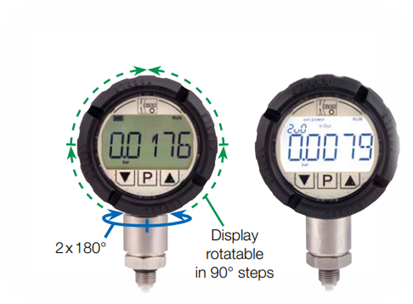
A digital pressure gauge works by using an electronic pressure sensor—commonly based on technologies like strain gauge, piezoresistive, or piezoelectric principles—to detect the applied pressure. The sensor converts this mechanical pressure into a proportional electrical signal. This signal is then amplified, processed by an internal microprocessor, and displayed as a precise pressure reading on the digital screen. The result is an accurate, real-time measurement in selectable units such as bar, psi, or kPa.
For more information, watch the video with a detailed overview.
What are the key features of digital pressure gauges?
Digital pressure gauges offer a range of features that enhance accuracy, usability, and versatility across various applications. Some of the key features include.
- High Accuracy: Equipped with electronic sensors, digital pressure gauges provide precise and consistent readings, allowing even small pressure changes to be detected accurately.
- Clear Digital Display: The pressure values are displayed in a numerical format on an LCD or LED screen, making them easy to read and minimizing the risk of human error associated with analogue dials.
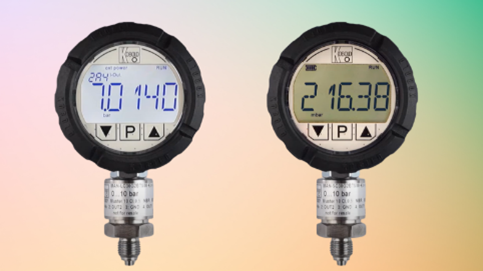
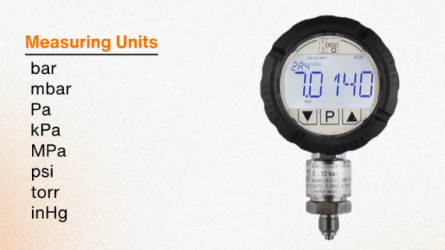
- Multiple Measurement Units: Many models allow users to switch between different units such as psi, bar, kPa, and Pascal, providing flexibility for different regional or industrial standards.
- Data Logging and Remote Monitoring: Advanced digital gauges can store pressure readings over time and interface with external systems for real-time monitoring, data analysis, and reporting.
- Energy Efficiency: These gauges typically have low power consumption, especially when battery-operated, making them suitable for long-term use in remote or portable setups.
These features make digital pressure gauges ideal for industrial, laboratory, and field-based applications where reliability and precision are essential.
In which industries are digital pressure gauges used?
Digital pressure gauges are used across a wide range of industries where accurate and reliable pressure measurement is essential for safety, efficiency, and compliance. Key industries include:
- Automotive Industry: Used for measuring tire pressure, testing engine fuel and hydraulic systems to maintain vehicle performance and safety.
- Aerospace Industry: Employed in pressure testing for aircraft cabins and other critical components to ensure structural integrity and passenger safety.
- Oil and Gas Industry: Essential for monitoring pressure in pipelines, pumps, and processing equipment. Real-time data helps prevent leaks, system failures, and supports regulatory compliance.
- Medical and Healthcare Sector: Used in applications like monitoring blood pressure, managing oxygen tanks, and ensuring the accurate operation of life-support systems.
- HVAC (Heating, Ventilation, and Air Conditioning): Helps maintain optimal pressure levels in heating and cooling systems, contributing to energy efficiency and equipment longevity.
- Pharmaceutical and Laboratory Settings: Provides precise pressure control in research environments and production processes where exact conditions are critical.
- Maintenance and Calibration Services: Digital gauges are widely used in field calibration tasks, offering portable and precise measurements directly on-site.
These diverse applications highlight the importance of digital pressure gauges in any industry that values precision, safety, and operational efficiency.
Why choose a digital pressure gauge over an analogue one?
Digital pressure gauges offer several practical advantages over traditional analogue gauges, making them a preferred choice in many situations:
- Better Readability: Digital displays show clear numerical values, making it easier to read the pressure accurately at a glance—especially useful in dim or bright lighting, thanks to backlit screens.
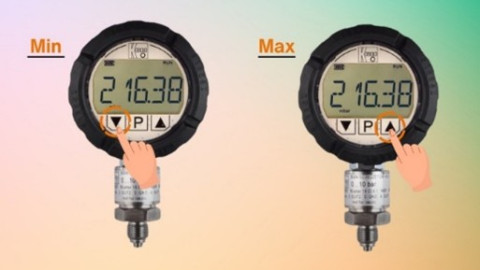
- Additional Information: Many digital gauges can show not just the current pressure, but also the maximum and minimum values recorded during use. This helps monitor pressure changes over time.
- Quick Pressure Trends: Some models include a simple bar or line display that gives an overview of how the pressure is changing—whether it’s rising, falling, or staying stable.
- Portable and Convenient: Since digital gauges are usually battery-powered, they can be used in various settings without needing a direct power source.
- Flexible Display Orientation: The screen on most digital gauges can be rotated, making it easier to view readings from different angles.
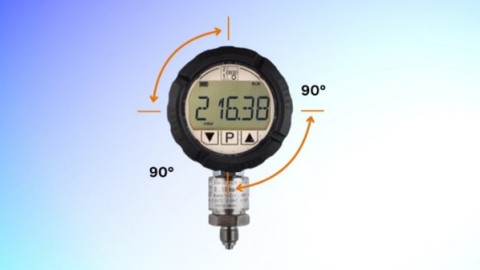
Overall, digital pressure gauges combine ease of use with useful features that enhance monitoring and decision-making in everyday pressure measurement tasks.
What are the key differences between digital and analogue pressure gauges?
| Feature | Digital Pressure Gauge | Analog Pressure Gauge |
| Installation | Easy to install | Easier to install due to simpler design |
| Power Requirement | Requires a power source (usually battery-powered) | Does not require power to operate |
| Cost | Generally, more expensive due to advanced features | It is typically more affordable |
| Reading Accuracy | It provides precise and stable readings | It may be less accurate, especially for small fluctuations |
| Display Readability | Clear digital screen with backlighting for low-light use | Readings depend on needle position; less visibility in low light |
| Additional Features | Often includes max/min values, unit conversion, data logging | Limited to basic pressure indication |
How accurate are Digital Pressure Gauges?
The accuracy of a digital pressure gauge refers to how closely its reading matches the actual pressure being measured. It is usually stated as a percentage of the gauge’s measurement range.
Several factors can affect the accuracy of a digital pressure gauge, including:
- Non-linearity: Small inconsistencies in how the gauge responds across the full range.
- Hysteresis: Slight variations in readings when pressure increases versus when it decreases.
- Zero offset: Deviation from zero when there is no applied pressure.
- Span error: Differences in readings across the entire measurement range.
- End value deviation: Variations at the upper or lower limits of the scale.
Digital pressure gauges are generally more accurate than analogue types and are suitable for applications where precision is important. If you require guidance in selecting the right gauge for your needs, consulting an expert is recommended.
What are the advantages of using a Digital Pressure Gauges?
Digital pressure gauges offer several key benefits that make them a preferred choice in many industrial and professional settings. These advantages include:
- High Accuracy: Digital gauges provide highly precise and consistent pressure readings, making them ideal for applications where measurement reliability is critical.
- Easy to Read: The clear digital display minimizes interpretation errors, unlike analogue gauges where needle positioning can be misread.
- Multiple Unit Options: Users can switch between various pressure units such as bar, psi, or kPa, depending on application requirements.
- Portable and Flexible: Many models are battery-powered or loop-powered, allowing for easy use in field operations without the need for a constant power supply.
- Data Logging Capabilities: Some digital pressure gauges can record and store pressure readings over time, enabling performance monitoring and data analysis.
- Durability and Robust Design: Built to withstand tough industrial environments, digital gauges typically have a rugged construction and are more resistant to damage from overpressure.
- Alarm and Alert Functions: Advanced models offer programmable alarms to notify users when pressure readings exceed or fall below set thresholds.
These features make digital pressure gauges a versatile, reliable, and user-friendly option for a wide range of pressure measurement tasks.
Are there any disadvantages of Digital Pressure Gauges?
Yes, while digital pressure gauges offer many benefits, they also come with a few limitations that should be considered depending on the application:
- Battery Dependency: Most digital gauges require batteries or an external power source to operate. This means regular battery replacement or charging may be necessary, especially in remote or continuous-use settings.
- Higher Initial Cost: Digital pressure gauges are generally more expensive than analogue models due to their advanced features and electronic components.
- Risk of Electronic Failure: Without proper protection, digital gauges can be vulnerable to environmental factors such as moisture, dust, or electrical surges, which may lead to malfunction or failure.
- Limited Operating Temperature Range: The internal electronics of digital pressure gauges typically have specific temperature limits, which may restrict their use in extremely hot or cold environments.
What should you consider when choosing the right Digital Pressure Gauge?
- Accuracy: Choose a gauge that provides reliable and consistent readings for your intended application. Higher accuracy is important for tasks that require precise monitoring.
- Display Type: Digital gauges typically feature either LCD or LED displays. Consider which type is easier to read in your working environment, especially in low-light or outdoor conditions.
- Pressure Range: Ensure the selected gauge covers the pressure range required for your application. Using a gauge with a suitable range improves reading reliability and helps avoid measurement errors.
- Application Environment: Think about where and how the gauge will be used. For example, gauges used outdoors or in harsh conditions may need weather or chemical protection.
- Portability or Fixed Use: Decide whether the gauge will be used in a fixed location or needs to be portable. Some digital gauges are designed specifically for on-the-go use, while others are more suitable for permanent installations.
- Unit Display Options: Many digital gauges allow you to select from multiple pressure units (like bar, psi, or mbar), making it more convenient and reducing the risk of conversion mistakes.
- Response Time: In some applications, the speed at which the gauge updates its readings (measuring speed) can be important, especially when quick pressure changes need to be tracked.
- Certification (if needed): For certain professional or regulated environments, it may be necessary to choose a gauge that comes with calibration certification to confirm its accuracy.
Considering these factors will help ensure you select a digital pressure gauge that performs effectively and reliably for your specific requirements.
How should digital pressure gauges be maintained?
To ensure long-lasting performance and accurate readings, digital pressure gauges require regular maintenance. Key maintenance steps include:
- Battery Checks: Since many digital gauges run on batteries, it’s important to check and replace them as needed to prevent sudden shutdowns or data loss.
- Cleaning: Keep the display and sensor area clean by wiping them with a soft, dry cloth. Avoid using harsh chemicals or exposing the gauge to moisture and dirt.
- Protective Installation: Place digital gauges in suitable environments where they are protected from extreme temperatures, humidity, electrical surges, or other harsh conditions that may impact performance.
Why is calibration important for digital pressure gauges?
Calibration ensures the accuracy of digital pressure gauges over time. During calibration, the gauge is compared to a known pressure standard, and any necessary adjustments are made to keep the readings precise. Regular calibration is essential for applications where accurate pressure measurement is critical and helps ensure the gauge remains reliable throughout its use.
What is the typical measuring range of a digital pressure gauge?
Digital pressure gauges are available in a wide range of measuring capacities to suit different applications. A common measuring range spans from -1 bar (vacuum) to +1600 bar, allowing these gauges to measure both negative (vacuum) and high positive pressures. This wide range makes digital pressure gauges suitable for various industries, from low-pressure laboratory settings to high-pressure industrial systems.
What type of process connection is used in digital pressure gauges?
Many digital pressure gauges come with a stainless-steel process connection, which ensures durability, corrosion resistance, and compatibility with a wide range of fluids and gases. This makes them suitable for demanding industrial environments and long-term use.
What does the accuracy class indicate in a digital pressure gauge?
An accuracy class acc. to IEC 61298-2 is a performance characteristic of a pressure gauge, defining the maximum combined error from factors like non-linearity, hysteresis, and repeatability under reference conditions. The specific class value, expressed as a percentage of the measuring span, indicates the overall deviation of the instrument's actual output from its ideal performance. This helps users understand the level of precision the gauge offers and ensures the instrument is suitable for applications requiring reliable measurements.
How to choose the right accuracy class?
Select a gauge based on how critical accurate pressure measurement is to your process:
Critical applications (e.g., calibration labs, process control): Use gauges with high accuracy (0.1% – 0.5%).
- General industrial use (e.g., manufacturing, utilities): 1.0% accuracy is usually sufficient.
- Non-critical applications (e.g., HVAC, water supply): 1.6% or 2.5% is typically acceptable.
Using an overly accurate gauge in a low-importance application can unnecessarily increase equipment and maintenance costs. Conversely, using a low-accuracy gauge in a critical process may lead to incorrect decisions and safety risks.
What should be checked before installing a digital pressure gauge, and how is it installed?
Before installation, confirm that the system’s maximum pressure is within the gauge’s measuring range and that operating temperatures stay within allowable limits. Ensure all packaging materials are removed.
When installing, make sure the pressure line is completely depressurized. Mount the gauge as you would a mechanical manometer, using an appropriate seal for the thread connection. Always tighten the device by the designated fitting area, not by the housing. After installation, inspect all connections and piping for leaks to guarantee safe and reliable operation. To know more about the installation process, talk to our industry expert.
How is a digital pressure gauge used for load capacity or tensile force measurement applications?
Digital pressure gauges are commonly used in load capacity and tensile force measurement applications, such as with pull testers. In these setups, the gauge measures the hydraulic or pneumatic pressure applied during the test. By entering the reference area (e.g., piston or ram surface area), the gauge can automatically calculate the corresponding force using the formula Force = Pressure × Area.
Advanced models like the battery-powered MAN-SC and IO-Link-enabled MAN-LC support this feature. Users can configure the display to show either pressure, force, or alternate between both. This makes the device highly suitable for field and laboratory testing environments, such as:
Tensile load tests on materials and components
- Anchor and fastening tests in construction (per DIN EN 1090)
- Mechanical or structural conformity assessments
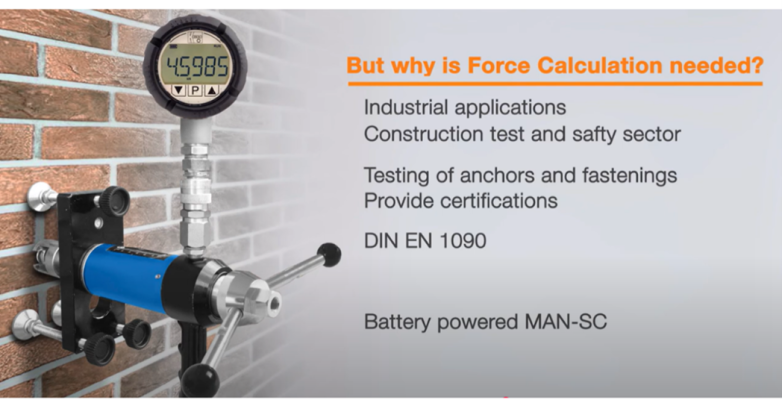
The large, high-contrast display ensures visibility even from a distance, and the user-friendly interface with touchpads allows easy setup. These gauges offer precise, real-time measurement and can be integrated into control or monitoring systems, making them ideal for mechanical testing, quality assurance, and engineering applications. To know more about it get in touch with us our technical expert will assist you.