Čeština
  Deutsch
  Español
  Français
  Italiano
  Magyar
  Nederlands
  Polski
  Português
  Slovenčina
  Türkçe
  Русский
  中文
中文  한국의
한국의 KOBOLD Instruments Inc • 1801 Parkway View Drive • 15205 Pittsburgh, PA • Tel: +1 412 788 2830 • E-mail: Please activate JavaScript • visit koboldusa.com

 Flow Indicators

Frequently Asked Questions (FAQs) – Flow Indicators
Flow indicators are simple devices used for visual flow monitoring in a pipe or process system. They do not measure how much fluid is moving. Instead, a flow indicator provides a quick visual confirmation that liquid or gas is flowing. This FAQ will explain what flow indicators are, how they work, their applications, and how they differ from other flow instrumentation, along with tips on selection, installation, and cost.
What is a Flow Indicator?
A flow indicator, also known as a sight flow indicator, visual flow indicator, or sight glass, is a device installed in a pipeline or process system to visually confirm that fluid or gas is moving through the line. In other words, it answers the basic question: “Is flow happening—yes or no?” Unlike a flow meter, a flow indicator does not quantify the flow rate or send electronic signals. It simply provides verification that flow is occurring by allowing you to see the movement of the media.
In many designs, the process media or an internal moving element is visible through a transparent window, allowing operators to confirm system operation at a glance.
The purpose of using a flow indicator is to support system monitoring and maintenance. Operators can quickly check a sight flow indicator to ensure that flow is present (and even observe flow direction) without needing complex instruments or data displays. This visual confirmation helps verify that pumps and valves are working, that cooling or lubrication loops have circulation, and that no blockages are present. In short, flow indicators provide a straightforward, reliable way to monitor flow presence and direction in real time, which helps maintain overall system reliability.
How Does a Flow Indicator Work?
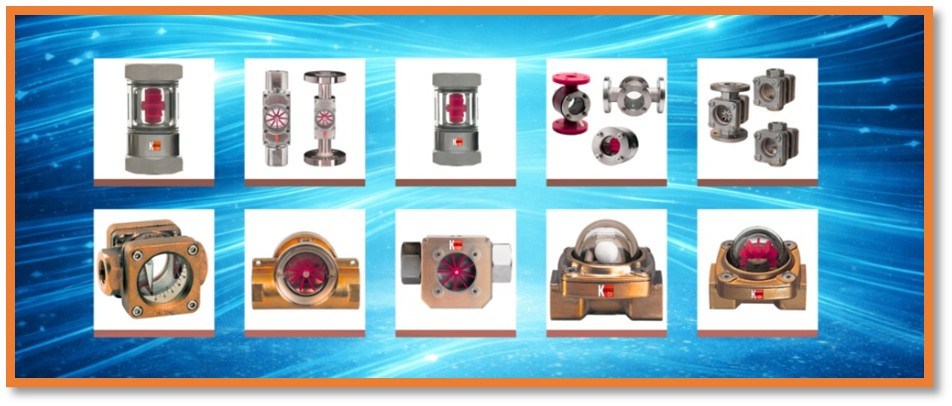
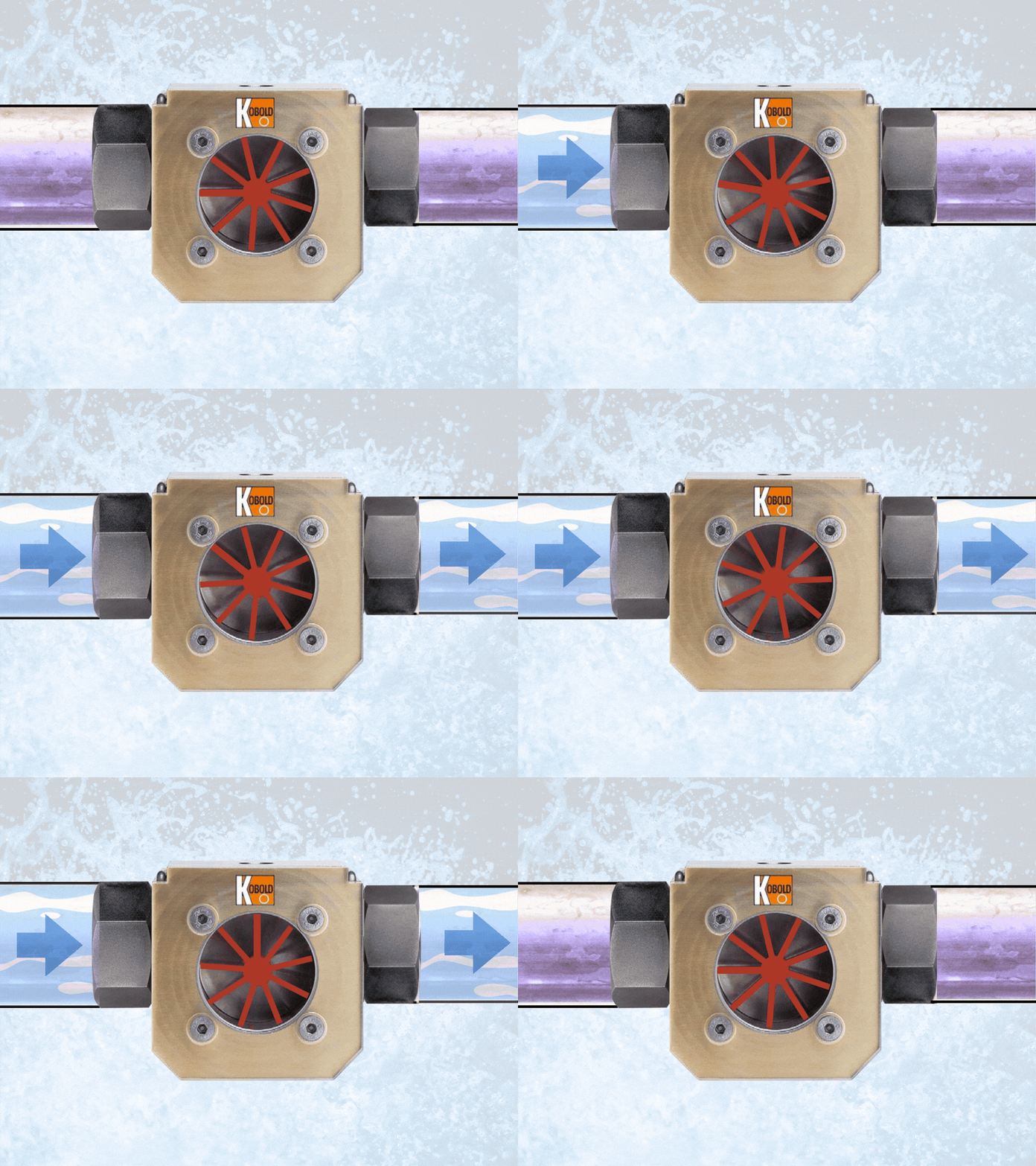
Flow indicators are generally mechanical devices that work by responding to the movement of fluid or gas as it passes through a device installed in a pipeline. When the fluid flows through the indicator’s body, it will usually move an internal element common designs use a small paddle wheel, propeller, floating ball, flapper, or hinged vane. The moving element is visible through a glass or plastic window, providing clear visual confirmation that flow is present. For example, flowing water might spin a rotor or lift a small ball, giving a clear visual cue that there is flow. In very simple indicators (like plain sight-glass windows), you confirm flow just by observing the liquid moving or dripping past the viewing window.
Because a flow indicator’s job is purely visual, there is no graduated scale or numerical readout to “read” as you would with a flow meter. To use a flow indicator, you simply observe whether the internal indicator piece is moving or not. If the paddle is spinning, the flapper is deflected, or the ball is lifted, then flow is present. No special calibration or interpretation is needed if you see movement, the fluid is flowing.
To know more or for application-specific guidance, please contact us.
What is the difference between Flow Indicators, Flow Meters, Flow Transmitters, Flow Switches, Flow Sensors, and Flow Restrictors?
Flow indicators are part of a broader range of flow instrumentation. Understanding how they differ from other flow devices helps in selecting the right instrument for a specific application.
- Flow Meters: A flow meter is designed to measure the flow rate (volume or mass per time) and often display that value or transmit that it. In contrast, a flow indicator does not measure flow quantitatively, it only provides a visual indication that flow exists. Some flow meters, such as variable area meters (rotameters) or mechanical meters with dials, include a visual element (a float position or pointer) that indicates flow. These devices may sometimes be informally referred to as “flow indicators” because they offer a visible indication of flow in addition to measurement. However strictly speaking, a true flow indicator (as defined here) offers yes/no confirmation of flow rather than an exact measurement.
- Flow Transmitters: A flow transmitter is essentially a flow meter that provides an electronic output (such as a 4–20 mA signal) to communicate the flow rate to other systems or controls. Like flow meters, transmitters measure flow rate (yes) and usually have an electrical output (yes), but typically they do not provide a local visual indicator (no). They are used when you need to send flow data to a PLC, control room, or data logger.
- Flow Switches: A flow switch is a device that triggers an electrical contact output when flow reaches a certain threshold. Its purpose is not to measure how much flow, but to detect if flow is above or below a setpoint (for example, to alarm or shut down equipment when flow stops or falls below a minimum). Many flow switches do not offer any visual indication (though a few designs might have a small viewing window or position indicator). They also don’t measure the exact rate – they just trip at a preset flow condition.
- Flow Sensors: “Flow sensor” is a general term for any device that detects flow. It can refer to many types of flow meters or switches. Depending on the specific device, a flow sensor might measure flow (some do, some don’t), might have a visual indicator (some do, some don’t), and might provide an electrical signal (often yes for electronic sensors). In short, flow sensor is a broad category and its capabilities vary by design.
- Flow Restrictors: A flow restrictor is a passive device that limits the flow to a fixed or maximum rate. It’s not actually an indicator or sensor at all – it’s simply a mechanical orifice or valve used to throttle or regulate the flow. Flow restrictors do not measure flow, nor do they give any visual indication or electrical output. They are purely used to achieve a desired maximum flow rate in a system.
The table below summarizes the key differences among these devices:
| Device Type | Primary Function | Measures Flow Rate | Provides Visual Indication | Electrical Output |
| Flow Restrictor | Limits flow to a preset maximum | No | No | No |
| Flow Sensor | Detects flow (general term, varies by type) | Varies | Varies | Varies |
| Flow Indicator | Confirms whether flow is present | No | No | No |
| Flow Switch | Triggers an action at a set flow point | No (threshold only) | Sometimes | Yes ( On/Off Switch) |
| Flow Transmitter | Measures flow and send signal to system | Yes | No | Yes |
| Flow Meter | Continuously measures and displays flow | Yes | Yes | Optional |
As shown above, a flow indicator vs. flow meter comparison highlights that flow indicators are simple visual tools, whereas flow meters (and transmitters) are measurement instruments. A flow meter or transmitter is chosen when you need actual flow rate data or automation, while a flow indicator is ideal for quick local verification of flow presence. Both device types can be useful, and in some systems, they might even be used together – for example, a flow meter might send data to a control system while a flow indicator provides immediate local confirmation of flow.
What pressure and temperature ranges are typically supported by flow indicators?
Flow indicators are designed to operate across a wide range of pressure and temperature conditions, depending on their design, materials of construction, and sealing technology. Simple sight flow indicators especially smaller or plastic-bodied models—may be limited to relatively low-pressure levels, on the order of 6 bar (about 85–90 psi).
On the other hand, industrial high-pressure flow indicators constructed with robust metal housings and reinforced glass can handle pressures of up to around 40 bar (PN40) in some designs.
In terms of temperature, standard indicators made from materials such as brass or PVC typically support fluids up to roughly 80–120 °C, while specially built high-temperature units with stainless steel and high-temperature gaskets can tolerate temperatures of 200 °C or even 260 °C.
When selecting a flow indicator, always check the specifications of a given flow indicator model to ensure it is rated for the maximum pressure and temperature in your application. Factors such as the body material (e.g. stainless steel vs. plastic), the window material (standard vs. borosilicate glass), and the seal materials will determine the exact limits. For very high-pressure or high-temperature systems, make sure to select a heavy-duty sight flow indicator designed for those conditions to ensure safe and reliable operation. To know more about the product, get in touch with our technical expert.
What are air flow indicators?
Air flow indicators are simply flow indicators used to verify the flow of air or other gases in a system. Most standard flow indicators for liquids can also work with air, since they rely on mechanical movement or visual observation which is not fluid-specific. However, when choosing a flow indicator for gas service, you should verify it meets the pressure requirements (gas systems can be high-pressure) and temperature range of your application. Also consider the cleanliness of the gas: if the air contains dust or other particulates, it could cloud the viewing window or jam a moving rotor/ball over time.
In short, as long as the flow indicator’s materials are compatible with the gas (for example, avoiding materials that might degrade with dry or oxygen-rich air) and the design is suitable (keep in mind that some indicators are calibrated for liquids and may respond differently with low-density gas flow), an air flow indicator is a convenient way to visually monitor airflow. Many manufacturers offer versions of their indicators specifically marketed for air or gas service.
What are water cooling flow indicators?
Water cooling flow indicators are used in systems where water is circulated to remove heat (for example, industrial cooling loops or high-performance electronics cooling). These indicators let you easily confirm that coolant water is flowing through the pipes, which is critical for preventing overheating. In a water-cooling system, a sight flow indicator installed in the coolant line provides an immediate visual cue that water is moving, so you can be confident the cooling loop is functioning.
It’s important to note the difference between using a simple flow indicator and a flow meter in cooling applications. A flow indicator shows that flow is present, but it won’t tell you the exact flow rate. In many basic cooling setups, this is sufficient you just need to know that some flow is happening. However, for larger or more sensitive cooling systems, a flow meter or flow transmitter can offer additional protection and control. Flow meters provide a continuous measurement of the water flow rate and can trigger alarms or system shut-offs if the flow falls outside of safe ranges. For example, a flow meter could detect a leak or blockage by sensing an unexpected drop-in flow rate, which is something a simple indicator would not catch. Flow meters can also transmit data to a central system or adjust pump speeds to maintain a target flow, whereas a flow indicator generally requires someone to be on-site to observe it.
In summary, water cooling flow indicators are a cost-effective way to visually verify coolant flow, but they do not replace flow meters when precise measurement or automatic control is needed. In high-value equipment cooling, you might use both: an inexpensive flow indicator for quick local checks, and a flow meter with sensors for continuous monitoring and alarm functionality .
Can Flow Indicators be used with Liquid Fertilizer?
Yes, Flow Indicators can be used with liquid fertilizers as long as you choose a model made from materials compatible with the fertilizer’s chemical properties. In fact, most any liquid flow indicator can serve as a liquid fertilizer flow indicator if it is built with corrosion-resistant components. Many fertilizers are corrosive or contain solids, so selecting a rugged indicator (for example, one with a stainless-steel body and durable glass) is important. Standard water flow indicators can often handle fertilizers if their materials and seals are appropriate, but you should confirm the device is rated for any corrosive or abrasive aspects of the fluid. It’s also wise to use an indicator design that can tolerate suspended particles or higher viscosity; some simple rotor or ball indicators might clog or stick if the fluid is very dirty or thick.
Maintenance should also be considered. Fertilizers can leave residue or buildup on the sight glass over time. Choosing a sight flow indicator that is easy to clean (or even one with a self-cleaning mechanism) will help maintain visibility. For example, some flow indicators have built-in wipers or brushes on the window to clear off deposits without needing to shut down the system. Regular inspection and cleaning are recommended to ensure the indicator continues to function correctly in fertilizer service.
How are Flow Indicators Installed?
Flow indicators are straightforward to install. They are typically inline mechanical devices that mount directly into a pipeline, usually via threaded or flanged pipe connections. Unlike electronic flow sensors, flow indicators do not require power or signal wiring to connect and no programming is needed. You simply plumb the indicator into the pipe so that fluid flows through it, and then tighten it in place.
Best practices for installing a flow indicator include:
- Orientation and Flow Direction: Install the device according to the manufacturer’s flow direction arrow or markings, so that the fluid enters the inlet side properly. Ideally, position the indicator so that it stays full of fluid. (For example, many designs work best when mounted vertically with flow going upward, which keeps the indicator’s chamber completely filled.)
- Full Pipe Condition: Ensure that the pipe will remain full at the indicator’s location. If air can collect in the viewing area, it may give a false indication or make it hard to see the flow. Vertical upward flow installations help keep the indicator full of liquid.
- Avoid Pressure Surges: When starting up the system, open valves slowly to avoid sudden pressure spikes. Hammering or surge pressures above the instrument’s rating could crack the glass or damage the indicator mechanism.
- Pipeline Cleaning: Before installing, flush the piping to remove any debris, scale, or sediment. Particles can foul the indicator or scratch the viewing window, so it’s best to start with a clean line. It may also help to install a filter or strainer upstream if the fluid carries particles.
- Sealing and Support: Use the appropriate thread sealant or gaskets as required by the connection. Tighten the connections firmly but without overtightening (to avoid stressing any glass components). Make sure the indicator is adequately supported by the piping or mounts heavy indicators may need brackets to prevent stress on the pipe.
By following these guidelines, the flow indicator should operate reliably and provide a clear visual signal of flow. Always refer to the manufacturer’s installation instructions for any model-specific recommendations .
How much do flow indicators typically cost?
Flow indicators are generally more affordable than most other types of flow instrumentation. Because they are simple devices without electronic components, their price is usually lower than that of flow meters or flow switches. The exact cost depends on factors such as the materials of construction, pressure rating, size, and any special features. For instance, an all-plastic sight glass indicator for low-pressure use will cost less than a heavy-duty stainless-steel indicator rated for high pressure and temperature. Even the more industrial-grade flow indicators with metal bodies and glass windows tend to be cost-effective compared to full-fledged flow meters.
For demanding industrial applications, it is recommended to use robust, industrial-quality flow indicators, for demanding applications. Very cheap indicators (often made of lightweight plastic) intended for residential or light-duty use may not withstand the pressures, temperatures, or chemicals of an industrial environment. It’s better to invest in a robust, well-built indicator from a reputable manufacturer so that you get reliable performance and a long service life.
In general, flow indicators provide a cost-efficient solution for visual flow confirmation often priced in the tens or hundreds of dollars, which is economical compared to advanced flow metering devices.
Who manufactures flow indicators and how should the right one be selected?
Flow indicators are manufactured by many instrumentations and industrial equipment suppliers worldwide, offering a wide range of designs, materials, and operating ratings to suit different applications. These devices can vary in design from basic sight-glass windows to more sophisticated indicators with rotating paddles or balls and each manufacturer may have proprietary models with unique features.
When selecting the right flow indicator for your needs, consider the following factors
- Media Type: What fluid or gas will you be monitoring? Ensure the indicator’s materials (metal, plastic, elastomers) are compatible with the media to avoid corrosion or damage. For example, choose stainless steel or a chemical-resistant plastic for aggressive fluids like solvents or fertilizer, and ensure any seals or O-rings can handle those chemicals.
- Pressure and Temperature: Choose an indicator rated for the maximum pressure and temperature of your system (with a safety margin). Standard models might be rated for moderate conditions (e.g. up to ~10 bar and 100 °C), whereas specialized models can handle much higher ranges.
- Visibility Needs: Consider how easily you need to see the indication. Some models have a plain sight glass where you look directly at the fluid, while others include a moving contrast indicator (like a coloured spinner or ball) that is easier to see from a distance. If the indicator will be in a hard-to-see location, a more visible indicator style can be beneficial.
- Connection Size and Type: Make sure the indicator matches your pipe size and connection type (e.g. 1/2" NPT thread, 2" flange, etc.). It should fit seamlessly into your piping without significantly restricting flow. Also consider the indicator’s pressure drop good designs have minimal impact on flow when properly sized.
- Maintenance Features: If your fluid might cause coating or fouling, look for indicators with features like a self-cleaning wiper or a design that can be easily disassembled for cleaning. Also, check if replacement parts (like glass windows or seals) are available in case maintenance is needed.
- Certifications or Standards: In certain industries (food, pharmaceutical, etc.), you may need indicators that meet sanitary standards or specific certifications. Ensure the model you select complies with any industry regulations or standards relevant to your application.
- Manufacturer Support and Reliability: Choosing a flow indicator from an experienced and reputable manufacturer can make a difference in product quality and support. We offer expert guidance to help you select the best flow indicator for your application and budget. Don’t hesitate to contact us for advice as our expert recommend the appropriate model once you provide your requirements.
By evaluating these factors, you can confidently choose a flow indicator that meets your operational needs. Remember that the “right” flow indicator is one that will handle your process conditions, provide a clear visual indication, and hold up over time. If you are unsure, working with an experienced applications engineer or the manufacturer’s support team can help. Feel free to reach out to us for further assistance in selecting the ideal flow indicator for your system
Other Members of the KOBOLD group