Čeština
  Deutsch
  Español
  Français
  Italiano
  Magyar
  Nederlands
  Polski
  Português
  Slovenčina
  Türkçe
  Русский
  中文
中文  한국의
한국의 
High Pressure Accurate Low Flow Measurement
World’s Smallest Dual Tube Coriolis Mass Flow Meter for Preparative SFC System
For a full review please check our website by clicking the picture above
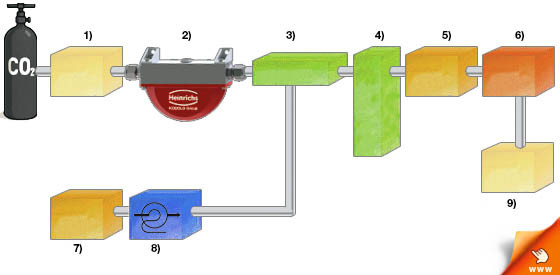
Schematic flow diagram of Preparative SFC (Supercritical Fluid Chromatography) system.
1) CO2 Pump
2) HPC Mass Flow Meter
3) Mixing Point
4) SFC Column
5) UV Detector
6) BPR
7) Modifier Pump
8) Injection Valve with sample loop
9) Waste
The image illustrates the entire flow path from the CO₂ supply (left) through the UV detector (5) and back-pressure regulator (BPR (6)) to waste/collection (right (9)). The CO₂ pump (1) delivers liquid CO₂ at high pressure (up to ~6000 psi). An inline HPC Coriolis mass flow meter (2) is installed after the CO₂ pump to monitor and validate the supercritical CO₂ flow. The HPC is the world’s smallest dual-tube Coriolis meter, capable of high-accuracy (±0.1%) measurement at very low flow rates and withstanding up to ~5800 psi. It provides mass-flow feedback to maintain stable CO₂ flow, which is critical for reproducible SFC separations.
CO₂ Supply & High-Pressure Pump
Liquid CO₂ is pressurized by a high-pressure pump to exceed supercritical conditions (typically up to ~400 bar / 6000 psi, with flow rates around 3–12 kg/h), forming the main mobile phase.
HPC Coriolis Mass Flow Meter (High-Pressure Validation)
Installed immediately after the CO₂ pump, the Heinrichs HPC Coriolis meter provides real-time mass-flow validation under supercritical conditions. Its dual bent-tube design with coils between tubes ensures extremely high accuracy (±0.1%), stable measurements at small flows, and robust immunity to vibration. It stands out as the world’s smallest dual-pipe Coriolis meter, engineered for high-pressure environments up to ~400 bar and temperatures up to ~180 °C.
Organic Co-Solvent Pump & Injection
A second pump (7) adds an organic modifier (e.g., methanol), which carries the injected sample from a valve loop (8) into the supercritical stream. The streams mix (3) just before the column.
Column, Detector & BPR
The mixed mobile phase passes through the chromatography column (4). The effluent then enters a detector (commonly UV), followed by a Back-Pressure Regulator (BPR) that maintains consistent system pressure to preserve supercritical fluid state throughout.
Separator & Collection
After pressure release via the BPR, the CO₂ expands into gas and is vented. The remaining liquid containing sample fractions is separated and collected safely without loss of resolution.