Čeština
  Deutsch
  Español
  Français
  Italiano
  Magyar
  Nederlands
  Polski
  Português
  Slovenčina
  Türkçe
  Русский
  中文
中文  한국의
한국의 KOBOLD Instruments Inc • 1801 Parkway View Drive • 15205 Pittsburgh, PA • Tel: +1 412 788 2830 • E-mail: Please activate JavaScript • visit koboldusa.com

 Capacitive Level Monitoring

Frequently Asked Questions Capacitive Level Switches
What is a Capacitive Level Switch?
A capacitive level switch is a device used for point level detection in tanks or containers, helping to indicate when a material reaches a predefined level such as high or low. It operates on the principle of Capacitance. The sensor probe and the tank wall form a capacitor. When the medium (liquid or solid) comes into contact with the probe, the dielectric constant changes, which is detected by the device and triggers an electrical output signal.
Capacitive level switches are suitable for both conductive and non-conductive media, including liquids, powders, and bulk solids. They are widely used in industries such as water treatment, chemical processing, and food production for reliable level control.
What is the working principle of a Capacitive Level Switch?
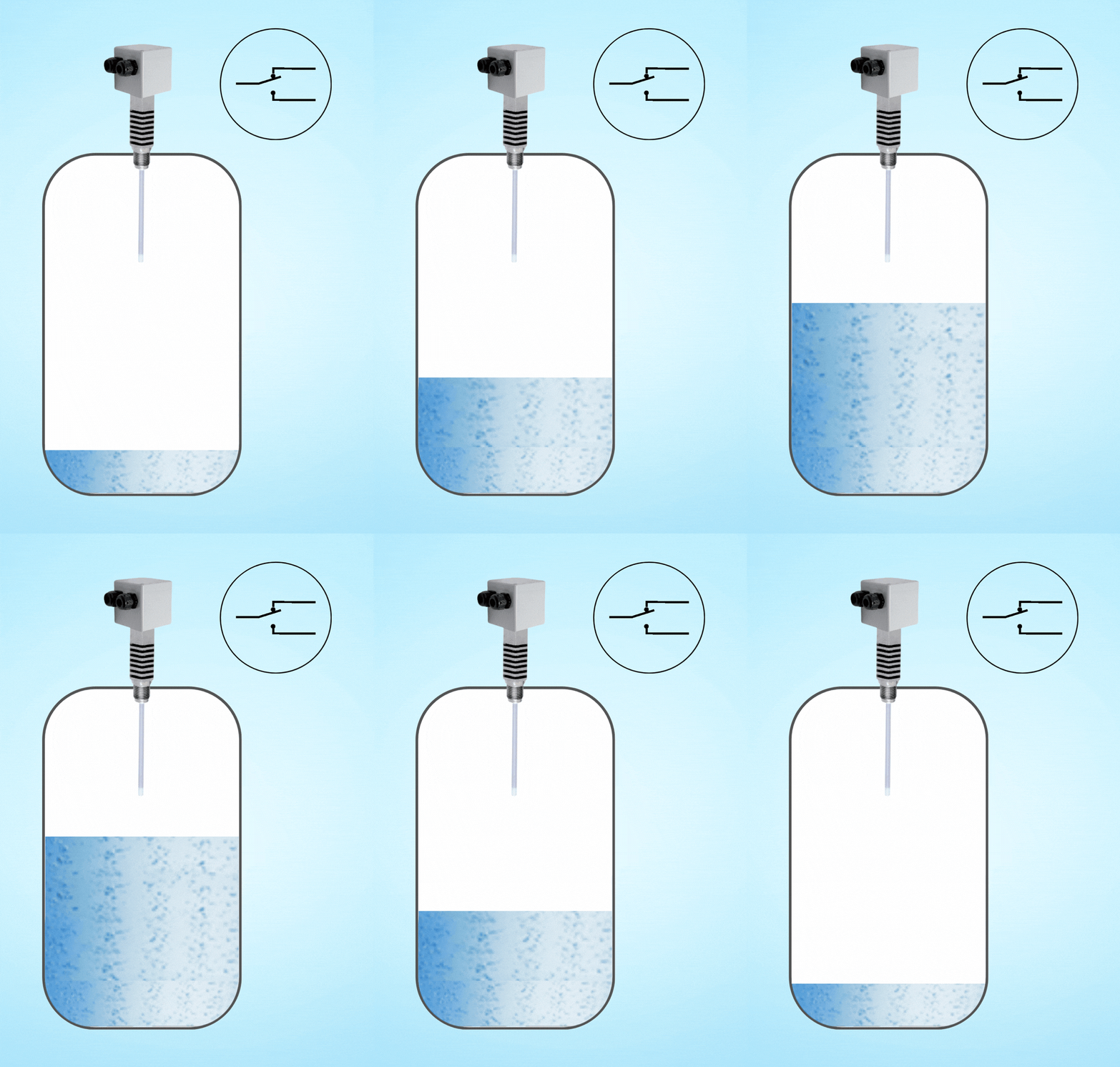
A capacitive level switch operates on the principle of Capacitance, where the sensor and the tank form a capacitor. The probe acts as one electrode, while the tank wall (or a reference electrode in non-metallic tanks) acts as the second electrode. When the probe is not in contact with the material, the space around it is typically filled with air, resulting in a stable and lower capacitance.
As the level of the material rises and comes into contact with the probe, the dielectric properties around the sensor change. Since different materials have different dielectric characteristics compared to air, this causes a measurable increase in capacitance.
The device continuously monitors this change, and when it reaches a predefined level, the switch is activated, generating an output signal to control processes such as alarms, pumps, or valves. This working principle allows the device to reliably detect levels in both conductive and non-conductive media, including liquids, powders, and bulk solids.
These devices typically have no moving parts, ensuring low maintenance and long service life. However, their performance can be influenced by factors such as material buildup, adhesion, or foam, which should be considered during selection and installation.
What are the applications of a capacitive level switch?
Capacitive level switches are used in a wide range of industries for accurate level detection:
- Level monitoring in conductive and non-conductive media: These switches can detect liquid levels regardless of electrical conductivity, making them suitable for both water-based and non-conductive fluids like oils.
- Reliable operation even in the presence of foam: They can maintain stable switching performance even when foam forms on the liquid surface, ensuring consistent level detection.
- Best suited for clean liquids (not recommended for heavy deposits): Capacitive switches perform best in applications without significant build-up or sticky deposits, as such conditions may affect measurement accuracy.
Typical fields of application include:
- Water and water-like liquids: Commonly used in tanks, reservoirs, and water treatment systems for basic level control.
- Liquid food products: Suitable for hygienic applications such as milk, juices, and other liquid foods where reliable level monitoring is required.
- Chemical and aggressive liquids: Can be used with compatible probe materials to handle corrosive or reactive substances safely.
- Oils and lubricants: Effective for monitoring levels in storage tanks and machinery where non-conductive fluids are used.
- Pharmaceutical liquids: Used in controlled environments where precision and reliability are important for process safety and quality.
- Bulk materials (cement, sand, minerals, flour, animal feed): It is Used in industrial storage and handling systems for level detection.
What are the advantages of a capacitive level switch?
Capacitive level switches offer several practical and operational advantages:
- No moving parts, ensuring low wear and long service life: Since there are no mechanical components involved, maintenance requirements are minimal and reliability is high.
- Easy installation and commissioning: These switches are simple to install and quick to set up, reducing downtime during deployment.
- Proven and robust measuring principle: The capacitive sensing method is well-established, providing safe and stable performance across various applications.
- Adjustable sensitivity for different media: Sensitivity can be tuned to suit different liquids and conditions, improving accuracy and flexibility.
- Suitable for minimum and maximum level detection: Can be configured for both low-level (dry run protection) and high-level (overfill protection) applications.
- Adaptable design with various probe lengths and configurations: Available in multiple lengths and designs to suit different tank sizes and installation requirements.
- Reliable operation in challenging media: Performs effectively even in viscous liquids and conditions with moderate build-up, depending on application setup.
- Convenient modular design: Features like pluggable evaluation modules make handling, replacement, and maintenance easier.
What are the operating pressure and temperature limits of a capacitive level switch?
Capacitive level switches are designed to operate across a wide range of pressure and temperature conditions, making them suitable for diverse industrial applications. Depending on the specific design and process requirements, pressure capabilities can vary from slight vacuum conditions (e.g., around -0.1 bar) up to higher pressures such as 10 bar or even 30 bar. Similarly, temperature limits can range from sub-zero conditions (e.g., -20°C) up to elevated temperatures of around 80°C to 100°C. These ranges may vary based on factors such as probe construction, material selection, and installation conditions.
For application-specific guidance, feel free to contact us for expert support.
What different models of capacitive level switches are available?
Capacitive level switches are available in different models, each designed to suit specific applications and installation conditions.
Here are some specific benefits:
- Capacitive Level Limit Switch-LNZ: This model is designed for direct level detection with integrated electronics, making installation simple without the need for additional evaluation units. It is well-suited for hygienic applications and processes involving cleaning systems. To know more about the product specification, click here.
- Capacitive Level Switch with Modular Design-NCW: This model features a probe with a plug-in evaluation module, offering flexibility for different applications. It is suitable for liquids, aggressive media, and non-metallic tanks, with various probe options available for specific process conditions. To know more about the product specification, click here.
- Capacitive Level Switch for Solids and Silos-NSC: This model is ideal for monitoring minimum and maximum levels in silos and storage containers. It is suitable for bulk materials such as powders and granules, with both rigid and cable probe options available for different installation needs. To know more about the product specification, click here.
Each model is designed to address specific industry requirements, ensuring reliable level detection across liquids and bulk solids. For help in selecting the right model, feel free to contact us.
What are the advantages of capacitive level sensors?
- It is Suitable for a wide range of materials including liquids, slurries, powders, and granular substances.
- High sensitivity enables accurate level detection even with small changes.
- It Works effectively in harsh conditions such as high temperature, pressure, and corrosive environments.
- Durable construction ensures long service life.
- Minimal moving parts result in low maintenance requirements.
- Provides reliable performance with less frequent recalibration.
- Cost-effective over time due to reduced maintenance and downtime.
What are the disadvantages of capacitive level sensors?
- Sensitive to material buildup on the probe, which can affect accuracy.
- Requires periodic cleaning in applications with sticky or powdery materials.
- Calibration can be challenging due to environmental changes (temperature, humidity).
- Performance may be affected by variations in dielectric properties.
- Not ideal for highly conductive materials.
- May face limitations with very fine powders or inconsistent materials.
- Higher initial cost compared to some other level measurement technologies.
How is a capacitive level switch installed?
A capacitive level switch is typically installed in a pipe or vessel at the desired level point where detection is required. The sensing probe must be positioned so that it comes into proper contact with the liquid or material to ensure accurate switching.
Installation can be done using a threaded connection or a suitable mounting arrangement, depending on the application. It is important to ensure proper sealing to prevent leakage and maintain process safety. While installing, avoid excessive tightening and repeated removal, as this may affect the sealing performance over time.
Before installation, always verify that the operating conditions such as temperature and pressure are within the recommended limits, and that the probe length is appropriate for the application. The sensor should be handled carefully to avoid damage and installed away from strong electrical interference for stable performance.
Can a capacitive level sensor work through a metal tank?
No. Metal tanks block the electric field required for capacitive sensing, which prevents accurate detection through the tank wall. In such cases, a probe-type capacitive level switch should be installed inside the tank through a suitable mounting point. Alternatively, technologies such as ultrasonic or radar level sensors can be considered.
Does liquid temperature affect capacitive sensing?
Yes, temperature can have a minor effect on capacitive sensing, as it slightly changes the electrical properties of the liquid. However, for most point-level switching applications, this impact is minimal and does not affect performance significantly. For more precise measurement requirements, sensors with temperature compensation are recommended.
What factors affect the performance of a capacitive sensor?
- Dielectric properties of the target material: The sensor operates based on changes in dielectric constant. Variations in material properties directly affect the sensor’s ability to detect and measure levels accurately.
- Distance between the sensor and the object: The sensing range and accuracy depend on the proximity of the material to the sensor. Greater distances can reduce sensitivity and lead to less precise measurements.
- Environmental conditions (temperature and humidity): Changes in temperature and humidity can alter the dielectric properties of materials and affect sensor electronics, leading to measurement drift.
- Presence of nearby conductive or dielectric materials: External objects or buildup around the sensor can interfere with the electric field, causing false or unstable readings.
- Sensor design and calibration: The type of sensor, probe design, and proper calibration play a crucial role in ensuring consistent and accurate performance across different applications.
- Stability of the power supply: Fluctuations in power supply can impact the sensor’s signal processing and output stability, resulting in unreliable measurements.
How should a capacitive switch be maintained?
Capacitive switches generally require minimal maintenance due to their simple and robust design. However, regular inspection is recommended to ensure reliable performance. Key maintenance practices include:
- Checking electrical connections for any signs of looseness, wear, or damage.
- Inspecting the sensor surface and surrounding area for buildup or contamination.
- Cleaning the switch periodically to remove dust, dirt, or residue that may affect sensitivity.
Proper maintenance helps ensure consistent operation and extends the service life of the switch .
Are capacitive level sensors suitable for reliable level measurement in industrial applications?
Capacitive level sensors are a reliable and widely used solution for industrial level measurement, particularly where accuracy and versatility are required. They are capable of measuring a variety of materials and perform well across different operating conditions.
However, their effectiveness depends on proper application. Factors such as material properties, environmental conditions, and potential buildup on the sensor must be carefully considered. While they may require periodic calibration and maintenance in certain cases, their overall benefits in precision and adaptability often outweigh these limitations.
When selected and implemented correctly, capacitive level sensors provide dependable performance and contribute to efficient and controlled industrial processes. To know more about the Level solution visit us or contact our technical expert.
Other Members of the KOBOLD group